HT Panel Testing Before Commissioning: The Key Tests Explained
The pre-commissioning tests that prove an HT panel is safe to energise, what each one checks, and why none of them should be skipped.
- 5 min read
- 3 sections · 3 FAQs
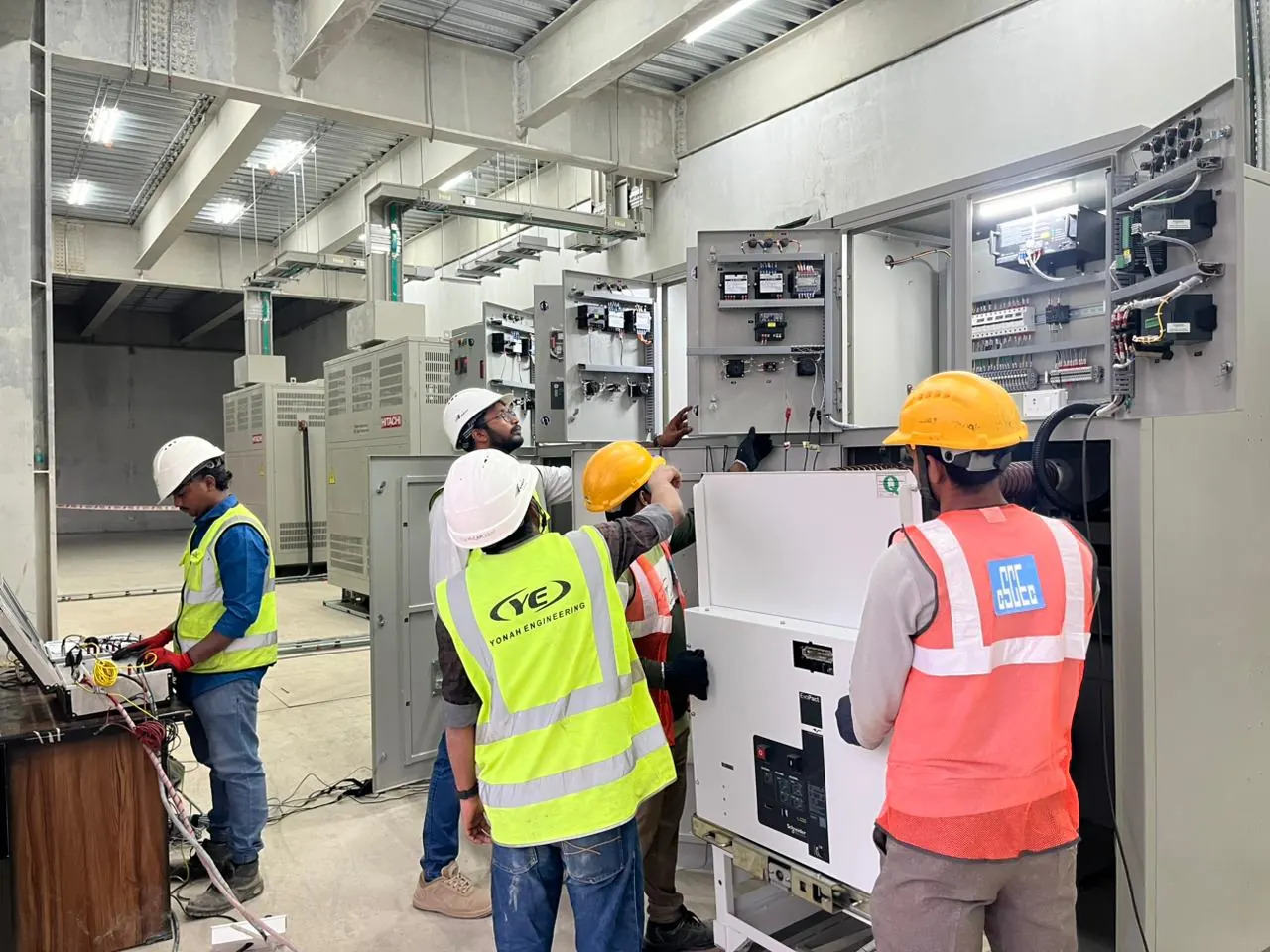
An HT panel arrives on site with factory routine test reports, so it is tempting to treat site testing as a formality. It is not. Transport, handling, installation, cable termination and relay setting all happen after the panel leaves the factory, and any of them can introduce a fault that only shows itself when the panel is energised at 11 kV, 22 kV or 33 kV.
Pre-commissioning tests confirm that the switchgear, protection and cabling are safe to energise and will clear a fault when they need to. This article explains the tests our engineers typically carry out and why each one matters. Test voltages, acceptance values and sequence should always follow the manufacturer’s instructions, the project specification and the relevant standards.
Tests on the switchgear itself
These tests check that the panel and its circuit breakers are mechanically sound and electrically healthy.
Visual and mechanical checks
Before any instrument is connected, the panel is checked against the drawings and nameplate data. Engineers look for transit damage, busbar alignment and tightening torques, clearances, clean and dry insulators, working shutters, and a continuous panel earth bus connected to the main earthing system. Breakers are racked in and out, springs are charged and released manually, and position indicators are verified. Many later faults start as a loose joint or missing bolt that could have been found at this stage.
Insulation resistance and withstand tests
An insulation resistance (IR) test with a suitable tester, commonly 5 kV for 11 kV equipment, is taken phase to phase and phase to earth with the breaker both closed and open. Readings are compared between phases and with the manufacturer’s guidance; consistency between phases is often as informative as the absolute number.
Where the specification calls for it, a power frequency or VLF withstand test follows at a site test voltage, usually a reduced proportion of the factory test value. Applying voltage across the open contacts of a vacuum breaker also helps confirm the interrupters have not lost vacuum. IR is normally repeated after any high-voltage test.
Contact resistance
A micro-ohmmeter injects a DC current, typically 100 A or more, through each closed breaker pole and busbar joint and measures the resistance in micro-ohms. A high or unbalanced reading points to poor contact pressure, contamination or a loose joint: the kind of defect that runs hot under load and can fail without warning. Results are compared across phases and with factory values.
Circuit breaker timing
A breaker analyser records closing and opening times, the spread between poles, and the operation of trip and close coils, including at reduced control voltage. A breaker that opens too slowly, or with poles out of step, may not clear a fault within the time the protection scheme assumes. Spring charging time and the anti-pumping function are usually checked at the same time.
Protection, instrument transformers and cables
A healthy breaker is only useful if it is told to trip at the right moment. These tests prove the chain from current or voltage signal to trip command.
Relay secondary injection
A secondary injection test set feeds calibrated currents and voltages into each protection relay to confirm that every function in use, such as overcurrent, earth fault, differential or under and over-voltage, picks up and trips at the approved settings. Those settings should come from a protection coordination study, so that the device nearest a fault trips first. The test should end with the relay actually tripping the breaker, not just operating a contact on the bench.
CT and PT tests
Current transformers are checked for ratio, polarity, insulation resistance and winding resistance. For protection-class cores, a magnetisation (knee-point) test shows whether the CT will saturate during a fault. Voltage transformers are checked for ratio, polarity and insulation. A reversed CT can make a differential relay trip on healthy load or stay silent during a real fault, so polarity matters as much as ratio. Where practical, primary injection proves the whole circuit from CT to relay.
HV cable tests
Incoming and outgoing cables are tested after termination. IR is measured before and after a withstand test, which for XLPE cables is typically very low frequency (VLF) AC, since high DC test voltages are generally discouraged for XLPE insulation. Sheath integrity, continuity and phasing are also checked, so each core connects the phase the drawings say it does.
Interlocks, documentation and approval
Interlocks protect people, so each one should be proved by trying to defeat it. Typical checks: the breaker cannot be racked in or out while closed, the earth switch cannot be closed on a live circuit, doors cannot be opened in an unsafe condition, and any key or electrical interlocks between the HT breaker, transformer and LT incomer behave as designed.
Under the Central Electricity Authority safety regulations, originally notified in 2010 and since updated, HT installations generally need inspection and approval by the Electrical Inspectorate before they are energised. In Tamil Nadu this sits with the office of the Chief Electrical Inspector to Government. A complete, consistent commissioning file makes that inspection much smoother. It usually contains:
- Test reports with instrument details and calibration dates
- Relay settings as approved and as tested
- As-built single-line and wiring diagrams
- A list of any open points and how they will be closed
Frequently Asked Questions
Can we skip site tests if the panel has factory test certificates?
Factory tests prove the panel was built correctly, not that it survived transport and installation or that it was wired and set correctly on site. Pre-commissioning tests confirm the installed system is safe to energise, and inspectors and insurers will normally expect to see them.
Should HT panels be tested again after commissioning?
Yes. Periodic maintenance testing, typically IR, contact resistance, breaker timing and relay checks, helps catch deterioration before it causes an outage. The interval depends on duty, environment and the manufacturer’s recommendations, and many industrial sites align it with planned shutdowns.
Who decides the relay settings?
Settings should come from a protection coordination study that uses the utility fault level, transformer and cable data, and the downstream protection. The commissioning engineer then tests the relay against those approved settings rather than choosing them on the spot.